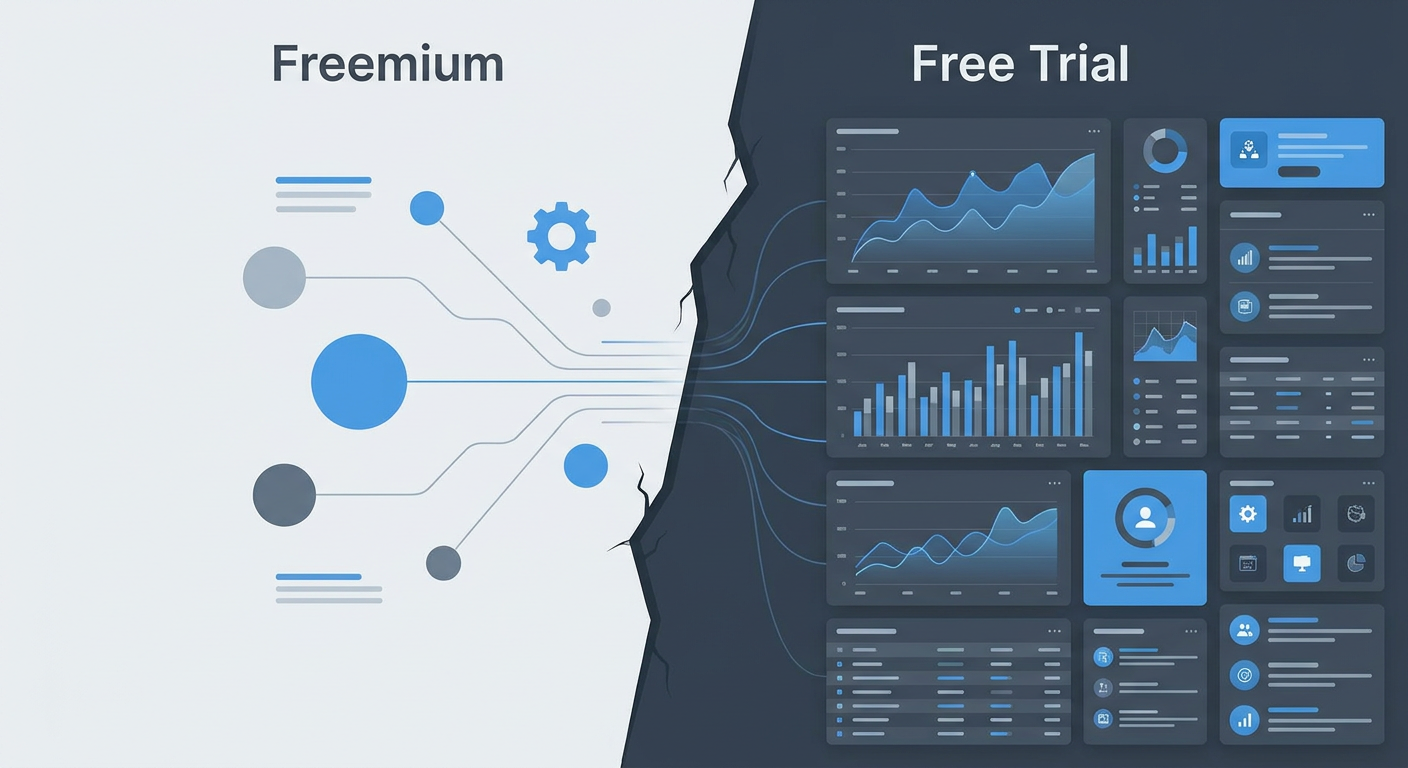

The choice between freemium and a free trial depends on your product's complexity and your target market. Free trials generally suit complex, high-value B2B SaaS sold to specific teams, creating urgency for a sales conversation. Freemium works best for simpler tools with a massive potential user base where the product itself can drive adoption at scale.
This isn't just a philosophical debate. It’s one of the most critical go-to-market decisions you'll make. And getting it wrong can cost you years of runway.
The Core Difference: Time vs. Features
Let's be clear on the definitions. They're often mixed up.
A free trial is a full-featured product experience, gated by time. Usually 7, 14, or 30 days. The goal is to get a user to a 'wow' moment quickly, see the full value, and want to pay before their access expires. It's an appetiser.
Freemium, on the other hand, is a permanently free, feature-limited version of your product. The gate isn't time; it's capability. Users can stay on the free plan forever, but they'll hit paywalls when they try to access advanced reports, add more teammates, or sync more data. It's a starter kit.
When to Choose a Free Trial
This model is the classic B2B SaaS approach for a reason. It works brilliantly under certain conditions.
Your Product is Complex and Needs a 'Wow' Moment
If your product requires some setup or data integration to really shine, a trial gives users the space (and the ticking clock) to do it. Think of a sophisticated analytics platform or a marketing automation tool. The value isn't obvious in five minutes.
The goal here is a guided experience. You want to get them to the point where they see a personalised dashboard or their first automated workflow fire. That's the moment they'll justify the price.
You Sell to Mid-Market or Enterprise
Larger companies have procurement processes. They run evaluations. A time-bound trial fits perfectly into this workflow. It creates a natural event—the end of the trial—that triggers a conversation with your sales team.
You're not trying to attract millions of users; you're trying to attract a few hundred high-value accounts. The trial acts as a powerful qualification mechanism. Did they invite teammates? Did they integrate their CRM? These are buying signals.
Your Sales Cycle is Consultative
When a salesperson adds significant value by helping a customer map their problems to your product's features, a trial is their best friend. They can see exactly what the prospect is doing (or not doing) and jump in to help.
This collaborative approach builds relationships and justifies a higher annual contract value (ACV). A free trial is the sandbox where that collaboration begins.
When Freemium Makes Sense
Freemium isn't just for consumer apps like Spotify. It can be an incredibly powerful B2B acquisition engine, but the conditions have to be right.
Your Product Has a Fast Time-to-Value
If a user can sign up and get tangible value in under two minutes, freemium could be a great fit. Think of a simple scheduling tool, a design element creator, or a document-sharing utility.
The barrier to entry is almost zero. This means you can acquire a massive volume of users through word-of-mouth and content marketing. Your product becomes your top-of-funnel. We’ve seen incredible growth models built this way, but the key is that initial, immediate spark of utility.
You Have a Massive Market & Viral Potential
Freemium models depend on scale. You need a huge Total Addressable Market (TAM) because you'll be converting a very small percentage of users to paid plans. If your tool is for, say, all project managers, that’s a big market. If it's for acoustic engineers in the marine biology sector, probably not.
The model really sings when the product has built-in viral loops. Does using your free product invite other users? For example, sharing a document or sending a meeting invitation created with your tool. Each free user becomes a marketing channel.
The Free Tier Seeds the Paid Tier
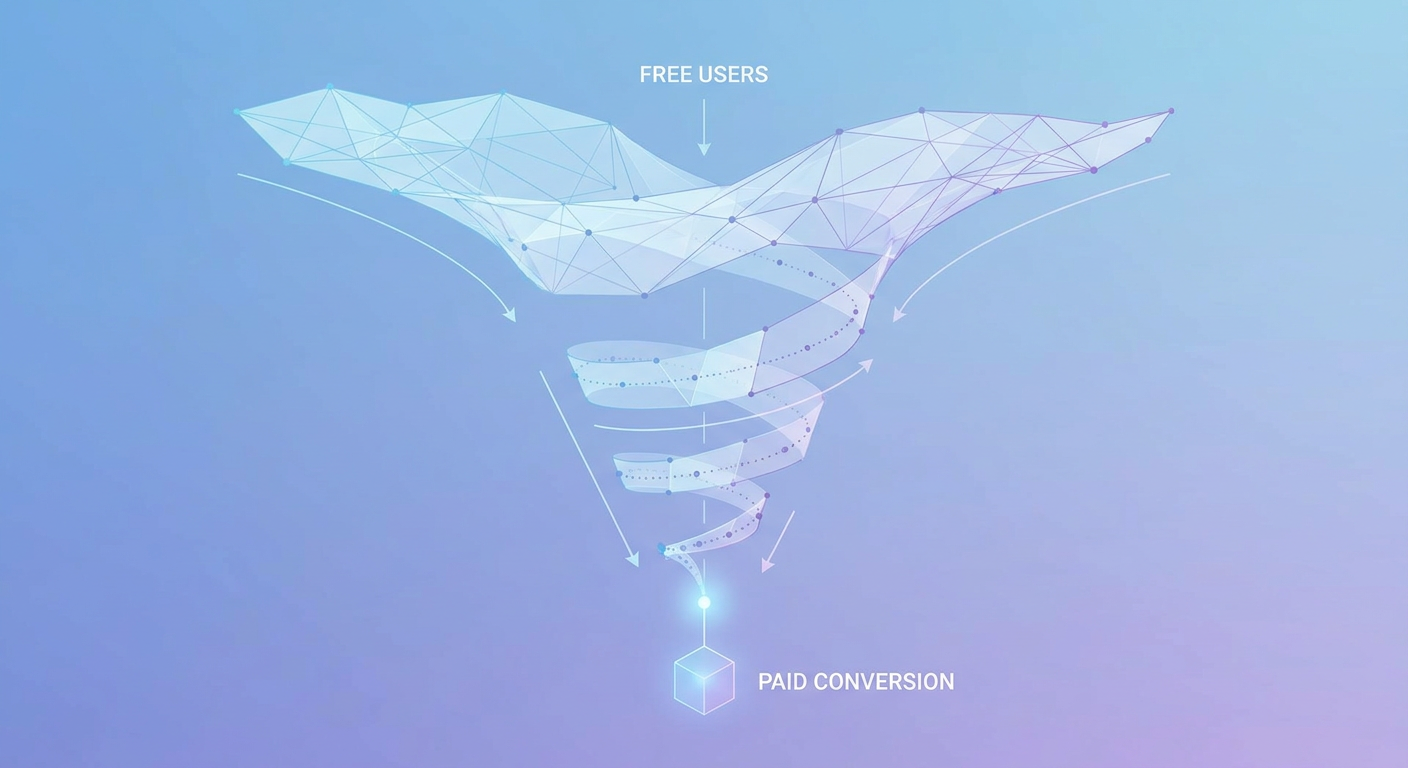
A well-designed freemium plan doesn't just give things away; it educates the user on the value of the paid plan. The limitations should be strategic. They hit a usage wall (You've used your 5 free reports this month) that's directly tied to a paid feature. This creates upgrade intent.
It's a long game. A user might use your free plan for a year before their team grows or their needs become more complex, triggering an upgrade. In our experience, these customers who upgrade after long-term free use are often incredibly loyal. But you need the runway to wait for that conversion, which is exactly where many companies struggle. It's why we've seen teams achieve fantastic results by focusing on lifting this specific conversion metric, just like in the Acme Coffee case study where they improved subscription conversion by 34%.
The Question of Data and The Hybrid Model
So how do you choose? It’s not about gut feel. It’s about data.
Before you commit, you must analyse your product and market. What's the natural user behaviour? Does the value compound with more usage and more features? Or is the core value simple and immediate? Connecting your product analytics to your CRM and marketing data is the only way to get a true picture. This is the core principle behind the entire Thrivio product, surfacing opportunities from your existing data stack.
There's also a third way: the hybrid model. This is becoming more common. A user signs up for a freemium plan, but immediately gets a 14-day trial of all the premium features. After 14 days, they revert to the free plan if they don't upgrade.
This can offer the best of both worlds. You get the low-friction acquisition of freemium, but also the urgency and full-product exposure of a trial. It gives users a taste of what they're missing, which makes the limitations of the free plan more obvious and painful. To do this well, you need a sharp understanding of user behaviour, often by digging into your raw data with smart tools – something you can even do by prompting your GA4 data with AI to find patterns.
What This Means for Your Growth
Choosing between a free trial and freemium isn't a permanent decision, but it sets the entire trajectory for your growth organisation. It dictates who you hire (sales-led vs. product-led), what you measure (MQLs vs. PQLs), and how you build your product.
A free trial focuses sales and marketing on a narrow band of highly qualified, in-market buyers. It’s about efficiency and velocity through a defined funnel.
Freemium is a volume play. It makes your product the primary driver of acquisition and relies on network effects and product experience to drive upgrades over a much longer time horizon.
Neither is inherently 'better'. The right choice is the one that aligns with your product's nature, your customers' behaviour, and your company's financial model. Start by looking at your data. The answer is usually hiding in there.