

Growth marketing and brand marketing aren't enemies. They’re two sides of the same coin, and both are essential for sustainable B2B success. Put simply, one captures demand, and the other creates it.
Too often, we see internal teams treating them as a zero-sum game, fighting for the same budget and headcount. This is a mistake. The best B2B businesses don't choose; they integrate. They build a system where brand makes growth easier, and growth proves the brand's promise.
The Core Difference: Mindset and Horizon
The biggest distinction between growth and brand marketing isn't the channels they use—both might use social media or content—but their core mindset and their time horizon.
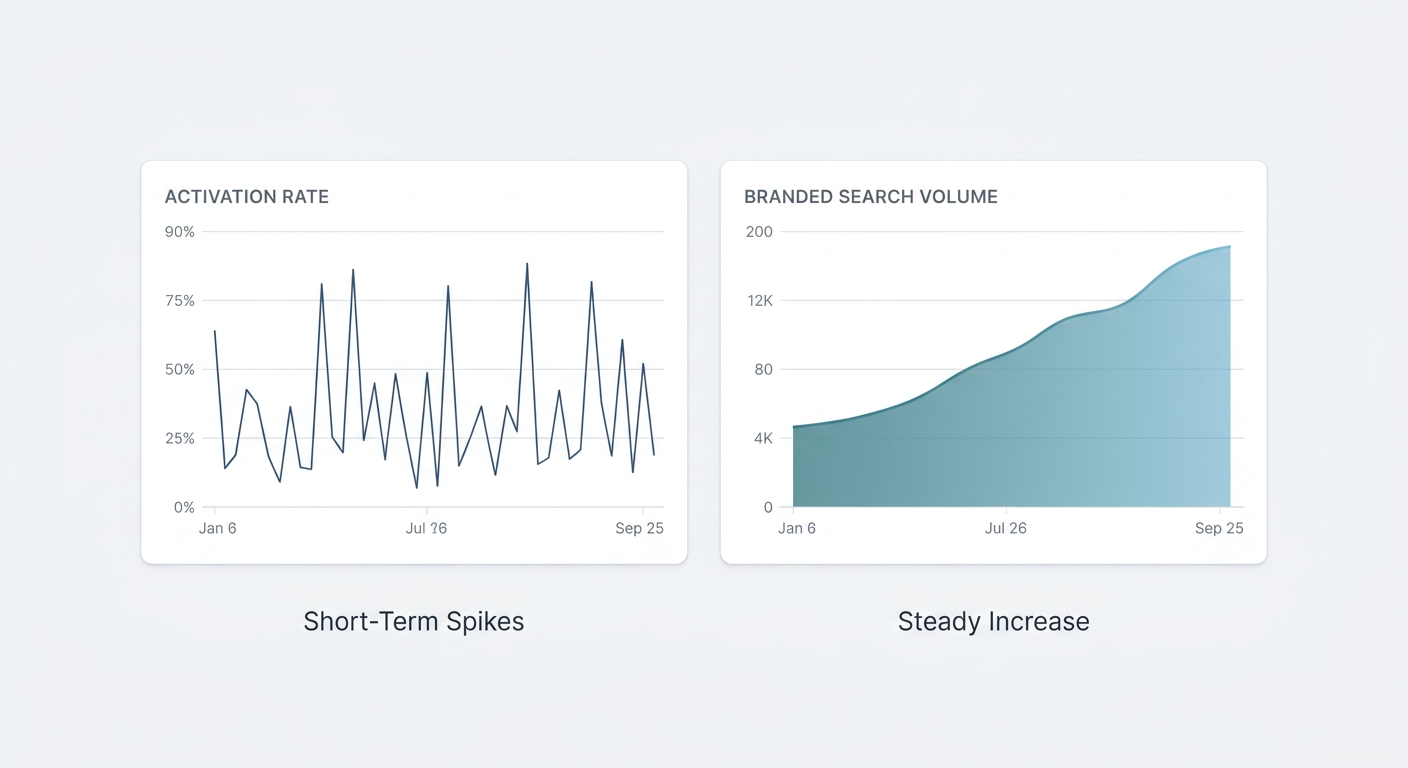
Growth marketing is a science of rapid experimentation. It’s focused entirely on moving specific, quantifiable metrics, usually in the short-to-medium term. Think weeks and months, not years. The core question for a growth marketer is: 'What can we test this week to get more qualified demos, lower our cost per acquisition, or improve our user activation rate?'
It’s about:
- Running A/B tests on landing page headlines.
- Optimising a paid ad funnel.
- Building and refining an email nurture sequence.
It is relentlessly data-driven and iterative. If an experiment doesn't produce a measurable result, it's discarded, and a new hypothesis is tested. The goal is to find scalable, repeatable systems for acquiring and retaining customers.
Brand marketing, on the other hand, plays the long game. Its goal is to build a powerful, lasting reputation and an emotional connection with the market. It’s less about this week's MQL count and more about becoming the first company that comes to mind when a potential customer thinks about the problem you solve. This is about building a true business asset.
What does that look like? It's about consistency and narrative. The brand team is asking: 'What story are we telling over the next three years? How can we build trust and authority in our category? Are we building a brand people want to be associated with?' The activities are different, too—investing in a definitive content series, building an industry community, or sponsoring the right niche podcasts. Its impact is measured in quarters and years.
One is the engine, the other is the iconic design and chassis. You need both to go anywhere meaningful, and you certainly need both to win the race.
How They Measure Success (It's Not the Same)
This is where most of the friction comes from. You can't judge a brand campaign with a growth yardstick, or vice versa. They're solving different problems and, therefore, have different key performance indicators.
Growth Metrics are Direct and Attributable
For a growth team, success is clear and directly attributable. The numbers don't lie. They're looking at things like:
- Cost per Acquisition (CAC): How much does it cost to get a new customer?
- Lead-to-Customer Conversion Rate: How efficiently are we turning interest into revenue?
- Activation Rate: Are new users getting to the 'aha!' moment in our product?
- Churn: How many customers are we losing?
These metrics are tracked in real-time. A growth marketer knows by Tuesday morning if last week's ad campaign changes worked. The feedback loop is tight. Making sense of all this requires connecting data across the entire funnel. That's the entire purpose of a growth intelligence product like Thrivio—to connect marketing data, your CRM, and even customer conversations to see what's actually driving revenue.
Brand Metrics are Slower, But Create Long-Term Value
Brand metrics are often seen as 'softer', but that doesn't make them less valuable. They just take longer to move. They're leading indicators that you're building a sustainable competitive advantage.
Key brand metrics include:
- Share of Voice: How much of the conversation in your category do you own compared to competitors?
- Branded Search Volume: Are more people typing your company's name directly into Google? This is a huge indicator of brand strength.
- Direct Traffic: An increase in visitors who type your URL directly into their browser means your brand recall is growing.
- Audience Engagement: Not just likes, but the quality of comments and conversations about your brand.
Analysing this used to be a huge manual effort. But now, new techniques are making it easier. For example, prompting your GA4 data with AI or running sentiment analysis on support tickets can reveal trends in brand perception almost as quickly as a growth marketer can check a conversion rate.
The Flywheel: How Growth and Brand Fuel Each Other
When you stop seeing them as separate functions and start seeing them as a system, a powerful flywheel effect emerges. Strong brand marketing makes every growth activity cheaper and more effective. And effective growth marketing validates the promises your brand makes.
Think about it. Who are you more likely to click on in a search result? A company you've never heard of, or one you recognise from a podcast or a great article you read last month? That's brand at work.
A strong brand creates a tailwind for growth:
- Higher Conversion Rates: People who already know and trust you are far more likely to convert. We've seen this directly with clients; a strong brand presence is often the difference-maker. For example, when Acme Coffee lifted their subscription conversion by reinforcing their quality messaging at key points, it showed how brand trust translates directly to revenue.
- Lower CAC: If more people are searching for you by name (branded search) or coming to your site directly, you're less reliant on expensive paid channels to drive traffic. Your 'free' organic channels become a powerful acquisition engine.
- Better Talent: The best people want to work for the best brands. A strong employer brand makes recruiting easier and cheaper.
On the other side of the flywheel, growth marketing delivers the proof. A brand might promise it's 'customer-centric', but a seamless, well-optimised onboarding flow—a growth-owned asset—is the proof. A brand can claim to be a 'thought leader', but it's the high-value, data-driven content used in a performance marketing campaign that demonstrates it. Each successful interaction a customer has with a growth-optimised touchpoint reinforces their positive perception of the brand.
What this means for your growth
Viewing growth and brand marketing as an 'either/or' choice is a trap. It forces a false decision between short-term results and long-term value. You don't have to choose. In fact, you can't.
Sustainable growth is built on the partnership between the two. One captures the demand that exists in the market right now. The other is busy creating the demand for all your tomorrows, building an asset that makes capturing that future demand easier and more profitable.
So, the next time you're in a budget meeting, stop asking, 'Should we invest in this brand campaign or this growth experiment?'
Instead, ask two different questions:
- How does this growth activity reinforce and prove our brand promise?
- How will this brand initiative create a tailwind for our growth engine in the next 6-12 months?
That's how you build a B2B company that not only grows but endures.